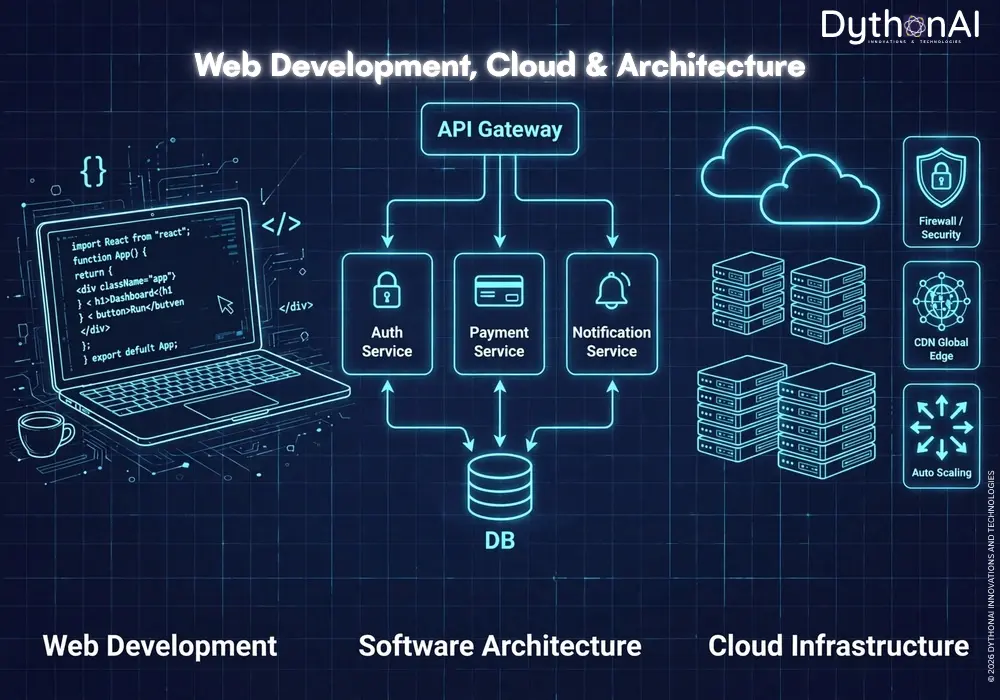
Web Development, Cloud & Architecture
Introduction
Every developer remembers their first deploy. You push a few files to a server, refresh the browser, and there it is: your work, live on the internet. It feels like magic.
Then the traffic grows. A second feature ships, then a tenth. A teammate joins, then five more. Someone in a meeting asks, “Can it handle ten times the users?” and the magic gets a lot more complicated.
That’s the moment when web development, cloud computing, and software architecture stop being three separate topics and become one conversation. They’re really one craft seen from different heights: the pixel on the screen, the infrastructure serving it, and the design holding everything together. Let’s walk through how they connect, what’s worth your attention, and which lessons tend to survive every technology trend.
The Front End Is No Longer “Just the Front End."
Not long ago, front-end work meant HTML, CSS, and a sprinkle of JavaScript. Today the boundary between client and server is wonderfully blurry.
Modern frameworks like React, Next.js, SvelteKit, Astro, and Nuxt let you decide, page by page, where the work happens: in the browser, on the server, or at build time. Server-side rendering, static generation, and streaming responses aren’t buzzwords. They’re levers. Pull the right one, and a page that once took three seconds to become useful feels instant.
This flexibility is powerful, but it also creates a new responsibility. When you can run code anywhere, you have to decide where it should run. A good rule of thumb: do as much as possible before the user asks, and send as little as possible when they do.
A few principles hold up no matter which framework is trending this month:
Performance is a feature. Users never read your Lighthouse score, but they absolutely feel a slow page. Ship less JavaScript, compress and lazy-load images, and measure real-user metrics instead of trusting your fast laptop on office Wi-Fi.
Accessibility is not optional. Semantic HTML, keyboard navigation, readable contrast, and meaningful labels make your product better for everyone, not just people who rely on assistive technology. It’s also simply good engineering.
Simplicity scales. The healthiest front-end codebases are the ones a new teammate can understand in a day, not a month. Clever code impresses for a week and frustrates for years.
Own your state. Many front-end headaches trace back to a tangled state. Decide what lives on the server, what lives in the URL, and what truly needs to live in the component.
The Cloud: Renting Superpowers
The cloud’s real promise was never “someone else’s computer.” It’s the ability to rent capabilities on demand: global distribution, managed databases, queues, object storage, machine learning services, and more, all available in minutes without buying a single server.
For a startup, that means launching with a handful of services and a credit card. For an enterprise, it means experimenting without waiting six months for hardware procurement. Either way, the economics of building software changed permanently.
Most teams meet the cloud through a few core building blocks:
Compute: virtual machines, containers, and serverless functions. The choice comes down to how much control you need versus how much operational work you’re willing to carry.
Storage and databases: relational, document, key-value, graph, and object stores. Picking the right one early saves painful migrations later, so match the database to the shape of your data and the way you’ll query it, not to what’s fashionable.
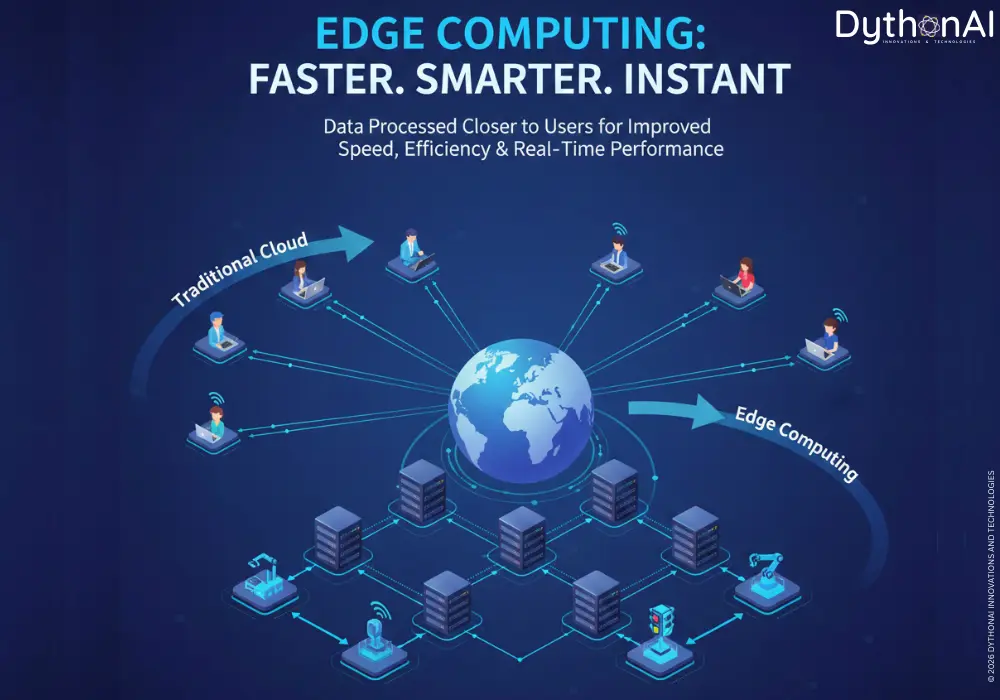
Networking and edge: CDNs and edge runtimes place your code and content physically closer to users. That cuts latency in a way no amount of code tuning can, because you can’t optimize away the speed of light.
Managed services: authentication, messaging, search, monitoring, email. Every service you don’t have to run yourself is one you don’t have to debug at 3 a.m.
The Quiet Danger: Cloud Sprawl
Here’s the part nobody mentions in the sales pitch. The cloud makes it easy to start things and just as easy to forget about them. A test environment left running, an oversized database, and a forgotten storage bucket add up quietly until the monthly bill arrives like a surprise party nobody wanted.
Build cost awareness in from day one. Tag every resource with an owner and a purpose, set budgets and alerts, and schedule a regular review of what’s running and why. The FinOps movement exists for a reason. Efficient cloud usage is an engineering skill, not just a finance task.
Architecture: The Decisions That Are Expensive to Change
If code is the bricks, architecture is the blueprint. It’s the collection of decisions that are cheap to make early and expensive to reverse later. Good architecture doesn’t mean predicting the future. It means keeping your options open while the future figures itself out.
Monolith or Microservices?
This debate has burned a lot of calories, so here’s the honest answer: start with a well-structured monolith unless you have a clear reason not to.
Microservices solve real problems, mainly organizational scale and independent deployment. But they also bring network failures, distributed debugging, versioning headaches, and heavy operational overhead. Many teams adopted them too early and ended up with a “distributed monolith,” which has the downsides of both worlds and the benefits of neither.
A modular monolith, with clean boundaries between domains, gives you speed today and an easy path to splitting services out later, once the need is proven rather than imagined.
Serverless or Containers?
Serverless shines for spiky, event-driven workloads and for small teams that want to move fast without managing infrastructure. Containers, often orchestrated with Kubernetes, offer portability and fine-grained control for steady, complex workloads.
Neither is “better.” They’re tools with different trade-offs, and plenty of successful systems use both. Choose based on your team’s skills, your traffic patterns, and how much operational complexity you can realistically absorb.
Event-Driven Design
When systems communicate through events rather than direct calls, components stay loosely coupled and failures stay contained. An order service can announce “order placed” without caring who’s listening, and new features can subscribe later without touching the original code.
It’s elegant, but it demands discipline. Events are harder to trace than function calls, so good observability and clear event contracts are essential, or you’ll spend your days wondering where a message went.
APIs as Contracts
Whether you choose REST, GraphQL, or gRPC, treat your API as a promise to everyone who depends on it. Version it, document it, and change it carefully. A breaking change you ship casually on Tuesday becomes someone else’s outage on Wednesday.
Data: The Part That Outlives Everything
Frameworks get rewritten and services get replaced, but data tends to live forever. Think carefully about your data model, your backup and recovery strategy, and where sensitive information is stored. Ask early: Who owns this data? How long do we keep it? What happens if we need to move it?
The Habits That Separate Good Systems from Fragile Ones
Technology choices matter, but habits matter more. The teams that ship reliably, sleep well, and keep their sanity tend to share a handful of practices.
Automate everything repeatable. CI/CD pipelines, automated tests, and infrastructure as code (Terraform, Pulumi, or CloudFormation) turn risky manual steps into boring, predictable ones. Boring is the goal. If a deployment is exciting, something is wrong.
Design for failure. Networks drop, services time out, and entire regions have bad days. Use retries with backoff, sensible timeouts, circuit breakers, and graceful degradation. Before launching any feature, ask the uncomfortable question: what happens when this breaks?
Invest in observability. Logs, metrics, and traces aren’t luxuries. If you can’t see inside your system, you’re debugging blind. Good observability turns a three-hour outage into a ten-minute fix.
Bake in security early. Least-privilege access, proper secrets management, dependency scanning, and strict input validation are far cheaper to build in than to bolt on after an incident. Security is a habit, not a milestone.
Test the way users behave. Unit tests catch logic errors, but integration and end-to-end tests catch the problems customers actually experience. Balance speed with realism.
Document decisions, not just code. A short architecture decision record explaining why you chose something is a gift to future teammates and to your future self, who will have forgotten everything by next spring.
Make it easy to roll back. Feature flags, canary releases, and blue-green deployments let you ship with confidence because undoing a mistake takes seconds, not hours.
AI Is Now Part of the Stack
It’s impossible to talk about modern development without mentioning AI. It’s showing up in two places at once: in how we build (coding assistants, automated code review, test generation) and in what we build (search, recommendations, conversational interfaces, summarization).
The architectural implications are real. AI features introduce new concerns: latency that varies wildly, cost per request, data privacy, and the need for fallbacks when a model returns something unexpected. Treat model calls like any other external dependency. Wrap them, set timeouts, monitor them, cache where it makes sense, and never assume they’ll always behave.
And remember that AI-assisted code still needs human judgment. A tool can generate a function in seconds, but only an engineer who understands the system can decide whether that function belongs there at all. The more code we can produce quickly, the more valuable good taste, review, and architectural thinking become.
Culture: The Layer Nobody Draws on the Diagram
Here’s something architecture diagrams rarely show: the people. Conway’s Law says that systems tend to mirror the communication structures of the organizations that build them. If your teams are siloed, your software will be too.
The best technical decisions come from teams that communicate openly, review each other’s work kindly, write things down, and treat incidents as learning opportunities rather than blame games. A blameless postmortem will improve your system more than any new tool. Invest in your team’s habits as seriously as you invest in your stack.
So Where Should You Start?
If this landscape feels overwhelming, take a breath. Nobody masters all of it, and you don’t need to. Start where you are.
Beginners: Get comfortable with the fundamentals: HTML, CSS, JavaScript, HTTP, and one database. Build something small, deploy it to a cloud platform, and watch what happens when real people use it. Nothing teaches faster than production.
Mid-level developers: Learn how your application behaves in the wild. Read your logs, trace a slow request from browser to database, and actually look at your cloud bill. Understanding the whole path of a request is a superpower.
Senior engineers and architects: Focus on trade-offs and communication. Write down the “why” behind decisions, mentor others, and remember that the best architecture isn’t the most impressive one. It’s the one your team can build, run, and evolve with confidence.
Everything above comes together in everyday client work, where a fast front end, sensible cloud choices, and a sturdy architecture all have to fit one real business. DythonAI is one team working in that space. They build custom web applications on Python and Django, along with AI-powered products, and have been doing it since 2022. If you're curious how these ideas look in practice, it's a great place to browse.
Final Thoughts
Web development, cloud, and architecture aren’t competing for your attention. They’re one story told at three levels: what users see, what powers it, and what holds it together.
Technology will keep changing. Frameworks will rise and fade, new cloud services will launch every month, and next year’s must-have tool will be this year’s legacy migration. But the core questions never change:
Is it fast? Is it reliable? Is it secure? Can the team understand it and change it?
Answer those well, and you won’t just build software that works today. You’ll build software that’s still working, and still improving, years from now.
What’s the biggest architecture decision you’ve faced, and would you make it the same way again? Share your story in the comments.