Generative AI vs Agentic AI: What's the Difference?
Introduction
Artificial Intelligence has evolved at an extraordinary pace over the last few years. While Generative AI has transformed the way we create content, code, images, and conversations, a new wave of innovation is emerging—Agentic AI. Although both technologies are built on advanced AI models, they serve fundamentally different purposes.
Understanding the distinction between Generative AI and Agentic AI is essential for businesses looking to leverage AI strategically. In this article, we'll explore what each technology is, how they differ, and which one is best suited for different business needs.
What is Generative AI?
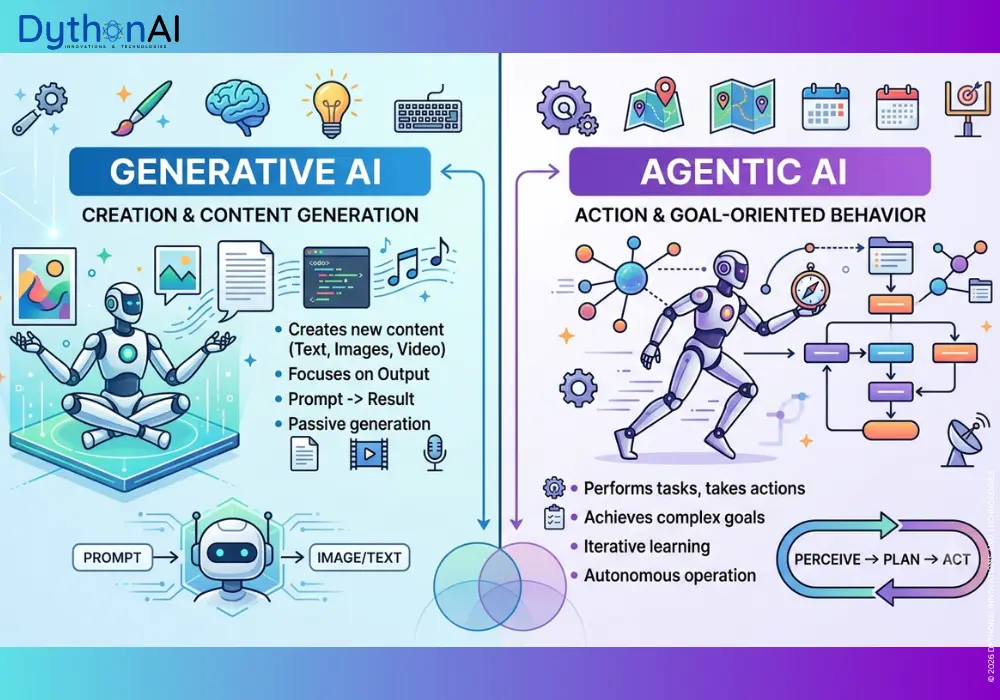
Generative AI refers to artificial intelligence systems that create new content based on user prompts. These models are trained on massive datasets and can generate human-like text, images, videos, audio, software code, and more.
Popular examples include AI-powered chatbots, content writers, image generators, and coding assistants.
Key Characteristics
Generates text, images, music, videos, and code
Responds to prompts provided by users
Produces creative and context-aware outputs
Assists humans rather than acting independently
Typically completes one task at a time
Common Business Applications
Marketing content creation
Blog writing
Customer support chatbots
Software development assistance
Image and video generation
Product descriptions
Email drafting
Documentation generation
What is Agentic AI?
Agentic AI represents the next evolution of artificial intelligence. Instead of simply generating content, Agentic AI systems are capable of planning, reasoning, making decisions, and executing multi-step tasks autonomously to achieve specific goals.
An AI agent doesn't just answer a question—it can analyze a situation, create a plan, interact with multiple software systems, monitor progress, adapt to changing conditions, and complete an entire workflow with minimal human intervention.
Think of it as the difference between asking someone to write a report versus assigning them the responsibility of completing an entire project.
Key Characteristics
Goal-oriented decision making
Autonomous task execution
Multi-step reasoning
Tool and API integration
Memory and contextual awareness
Adaptive planning
Continuous learning and optimization
A Real-World Example
Imagine you own an eCommerce business.
Using Generative AI
You ask AI:
"Write a product description for wireless headphones."
The AI generates a well-written product description within seconds.
Task completed.
Using Agentic AI
You assign the AI a goal:
"Increase sales of wireless headphones by 20%."
The AI agent could:
Analyze existing sales data
Research competitors
Identify customer buying trends
Create marketing content
Generate ad copies
Update product descriptions
Launch email campaigns
Monitor campaign performance
Adjust strategies automatically
Generate weekly reports
Instead of completing a single request, Agentic AI manages an entire business objective.
How Agentic AI Works
An Agentic AI system generally follows these steps:
1. Understand the Goal
It begins by interpreting the desired objective.
2. Plan
The AI breaks the objective into manageable subtasks.
3. Execute
It performs each task using available tools, APIs, databases, or software systems.
4. Monitor
The system continuously checks progress and evaluates outcomes.
5. Adapt
If conditions change or obstacles arise, it modifies its strategy to achieve the goal.
Benefits of Generative AI
Generative AI offers several advantages for businesses:
Faster content creation
Increased productivity
Reduced operational costs
Enhanced creativity
Better customer engagement
Quick software prototyping
Improved documentation
Benefits of Agentic AI
Agentic AI goes a step further by enabling organizations to automate complex processes.
Its advantages include:
Reduced manual intervention
Intelligent decision-making
Higher operational efficiency
Improved scalability
Continuous optimization
Better business outcomes
24/7 autonomous operations
Business Use Cases
Generative AI
Content marketing
Social media posts
Blog writing
Customer service responses
AI coding assistants
Graphic design
Translation
Knowledge assistants
Agentic AI
Autonomous customer support
HR recruitment automation
Supply chain optimization
Financial operations
Healthcare workflow management
Smart manufacturing
Sales automation
Business process automation
AI research assistants
Enterprise workflow orchestration
Challenges
Generative AI Challenges
Hallucinated or inaccurate information
Limited reasoning ability
Requires detailed prompts
Limited long-term memory
Cannot independently execute workflows
Agentic AI Challenges
Higher implementation complexity
Requires robust governance and oversight
Security and access control considerations
Integration with enterprise systems
Greater computational requirements
Which One Should Your Business Choose?
The answer depends on your objectives.
Choose Generative AI if you want to:
Generate content quickly
Improve employee productivity
Assist developers
Enhance customer communication
Create marketing assets
Choose Agentic AI if you want to:
Automate entire business processes
Reduce repetitive manual work
Enable intelligent decision-making
Build autonomous digital workers
Improve operational efficiency across departments
Many organizations will benefit from using both technologies together. Generative AI can create content and insights, while Agentic AI orchestrates workflows, makes decisions, and drives actions across systems.
The Future of AI
The future of artificial intelligence is not about choosing between Generative AI and Agentic AI—it is about combining their strengths.
Generative AI has revolutionized creativity and human-computer interaction. Agentic AI extends those capabilities by introducing autonomy, planning, and execution. Together, they form the foundation of the next generation of intelligent enterprise solutions.
Businesses that embrace this evolution early will be better positioned to innovate, streamline operations, and deliver exceptional customer experiences.
Conclusion
Artificial Intelligence is rapidly moving beyond content generation toward intelligent action.
While Generative AI excels at creating text, images, code, and ideas, Agentic AI is designed to independently plan, decide, and execute complex tasks to achieve business goals. Understanding the difference enables organizations to invest in the right AI solutions for their needs.
At DythonAI Innovations and Technologies, we help businesses harness the power of both Generative AI and Agentic AI to build smarter products, automate workflows, and drive digital transformation. Whether you're looking to integrate AI into your existing systems or develop next-generation AI-powered solutions, our team is ready to help you turn innovation into impact.
Ready to explore AI for your business? Contact DythonAI today and discover how intelligent automation can transform your organization.