Identity Verification in 2026
Introduction
Identity verification is becoming one of the most important trust layers for modern businesses.
As companies increasingly hire, onboard customers, provide digital services, and conduct transactions online, knowing who is actually on the other side has become more difficult—and more important—than ever.
In 2026, the challenge is no longer limited to fake documents.
Businesses now have to consider synthetic identities, manipulated documents, stolen credentials, impersonation, deepfakes, and AI-generated identities.
That is changing the way organizations think about identity verification.
The Identity Verification Problem Has Changed
Traditional verification often followed a relatively simple process:
Collect a document ? check the details ? approve the person.
But modern fraud can operate across several layers.
A fraudster may use:
- A genuine identity document belonging to someone else
- Manipulated or altered documents
- Stolen personal information
- Synthetic identities combining real and fake information
- AI-generated images or videos
- Deepfake-assisted impersonation
- Compromised accounts and credentials
India is experiencing this broader shift in its digital fraud environment. A 2026 TransUnion analysis found that 7.1% of attempted consumer transactions in India in 2025 were suspected digital fraud attempts, compared with 3.8% globally. The report also identified account login and account creation as important points of risk.
At the same time, India's cybersecurity authorities have highlighted the use of AI-generated deepfakes and synthetic identities to bypass systems including facial authentication, liveness verification and video-KYC processes.
This means businesses need to think beyond simply asking:
"Does this document look genuine?"
The better question is:
"Can we establish that this person is actually who they claim to be?"
What Is Modern Identity Verification?
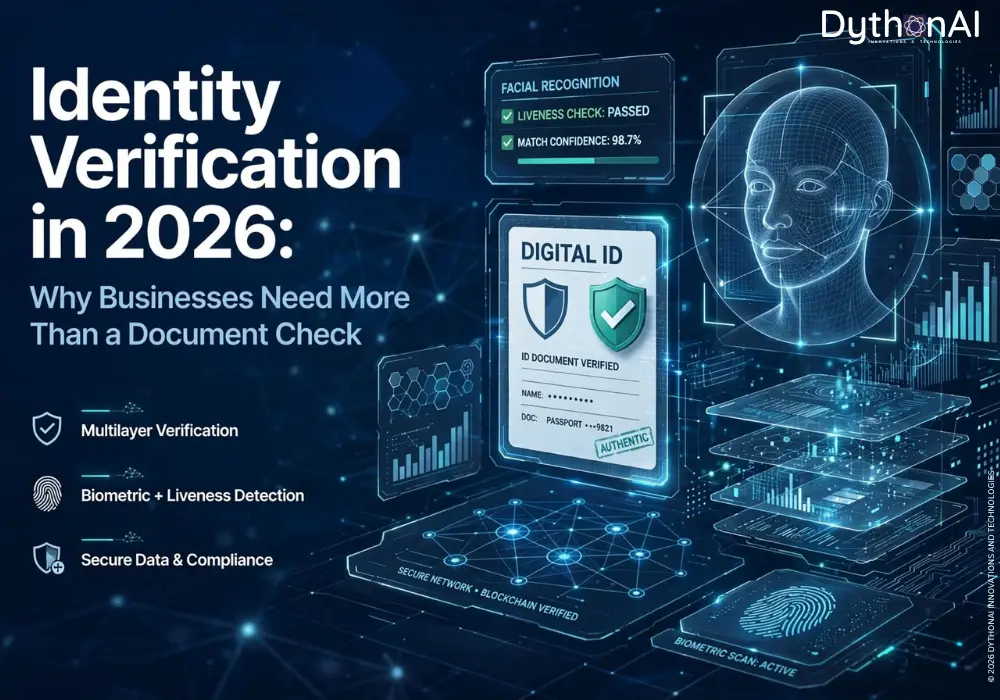
Modern identity verification is a process of establishing that an individual is genuinely associated with the identity information they provide.
Depending on the business and its risk requirements, this can involve multiple verification layers, including:
1. Identity Document Verification
The submitted identity document can be checked for relevant information, consistency and signs of manipulation.
2. Personal Information Verification
Information provided by an individual can be compared against the information required by the organization's onboarding process.
3. Identity Matching
Different pieces of information can be evaluated together rather than treating a single document as sufficient proof of identity.
4. Liveness and Facial Verification
Where appropriate, biometric and liveness technologies can help determine whether the person interacting with the verification system is a real person rather than a static image or presentation attack.
However, technology alone is not a complete solution. Research published in 2026 on responsible AI for identity verification also highlights the importance of privacy, explainability, bias management, governance and auditability.
Why AI Is Making Identity Verification More Important
Artificial intelligence is creating a paradox.
AI can help businesses automate identity verification, detect anomalies and process large volumes of information.
But the same technology can also make fraud more sophisticated.
Deepfake technology, for example, can be used to generate convincing images, voices and videos. India's Ministry of Electronics & Information Technology has specifically highlighted the growing challenge of AI-generated deepfakes and introduced additional measures addressing synthetically generated information in 2026.
The result is a new identity-security environment:
AI can help verify identity—but businesses must also prepare for AI-assisted identity fraud.
Identity Verification Is Especially Important During Hiring
Identity verification is not limited to banking and financial services.
It has an important role in recruitment and employee background verification.
A company may receive a candidate's:
- Resume
- Government-issued identity documents
- Address information
- Education documents
- Employment information
- Other verification documents
The challenge is managing this information securely while keeping the verification process convenient for candidates and HR teams.
Manual processes can involve email attachments, spreadsheets, shared folders and repeated follow-ups.
As hiring becomes increasingly digital, organizations are looking for ways to make verification workflows more structured.
From Document Collection to a Verification Workflow
This is where platforms such as Authiqo can help organizations rethink their background verification workflow.
Instead of treating verification as a collection of disconnected emails and files, a dedicated platform can provide a structured digital process for candidates and HR teams.
With Authiqo, organizations can build a more organized candidate-documentation workflow around their background verification process.
The objective is simple:
Make verification easier to manage, easier to track and more structured for everyone involved.
For candidates, that can mean a dedicated process for submitting required information and documents.
For HR and verification teams, it can mean having a centralized workflow instead of relying entirely on scattered email conversations and manual follow-ups.
The Future of Identity Verification Is Multi-Layered
The future is unlikely to be based on a single verification method.
Instead, businesses will increasingly combine multiple signals depending on the risk and purpose of the verification.
A modern verification workflow may involve:
Identity information
Document verification
Identity matching
Liveness/biometric checks where appropriate
Risk signals
Human review when required
Verification decision
This layered approach is particularly important because no individual verification mechanism is immune to every type of attack.
Academic research on AI-enabled KYC systems is increasingly exploring combinations of document forensics, liveness assessment, deepfake detection, OCR and risk engines rather than relying on a single verification signal.
Privacy Must Be Part of the Verification Strategy
There is another side to identity verification that businesses cannot ignore:
The more identity information an organization collects, the greater its responsibility to protect it.
Identity documents and personal information can be highly sensitive.
Organizations should therefore consider:
- What information is actually necessary?
- How is it collected?
- Who can access it?
- How long is it retained?
- Where is it stored?
- How is access controlled?
- How are verification decisions documented?
- What happens when a candidate requests information or clarification?
A good identity-verification strategy should therefore balance security, usability and responsible data handling.
Identity Verification Is Becoming a Business Trust Layer
Identity verification should not be viewed only as a compliance activity.
It can become part of a company's broader trust infrastructure.
Whether the organization is:
- Hiring a new employee
- Onboarding a customer
- Registering a business user
- Providing access to sensitive systems
- Performing background verification
- Managing high-value transactions
the fundamental requirement remains similar:
Know who you are dealing with.
And as digital interactions become easier to create, automate and manipulate, establishing that trust becomes increasingly important.
The Next Generation of Verification
The identity-verification industry is moving toward a more intelligent and layered model.
The question is no longer simply:
"Can we verify a document?"
It is increasingly:
"Can we establish identity with enough confidence, evidence and accountability for the decision we are making?"
That distinction matters.
For businesses, the goal should be to create verification workflows that are secure, structured, scalable and convenient—while keeping privacy and responsible technology use at the center.
Building Better Verification Workflows with Authiqo
Authiqo is designed around the idea that background verification should not have to depend on disconnected emails, manual document collection and fragmented workflows.
By bringing the candidate verification process into a dedicated platform, organizations can create a more structured experience for both candidates and verification teams.
Because verification isn't just about collecting documents.
It's about building trust in the people behind them.
Ready to modernize your background verification process?
Explore Authiqo and build a more structured verification workflow for your organization.