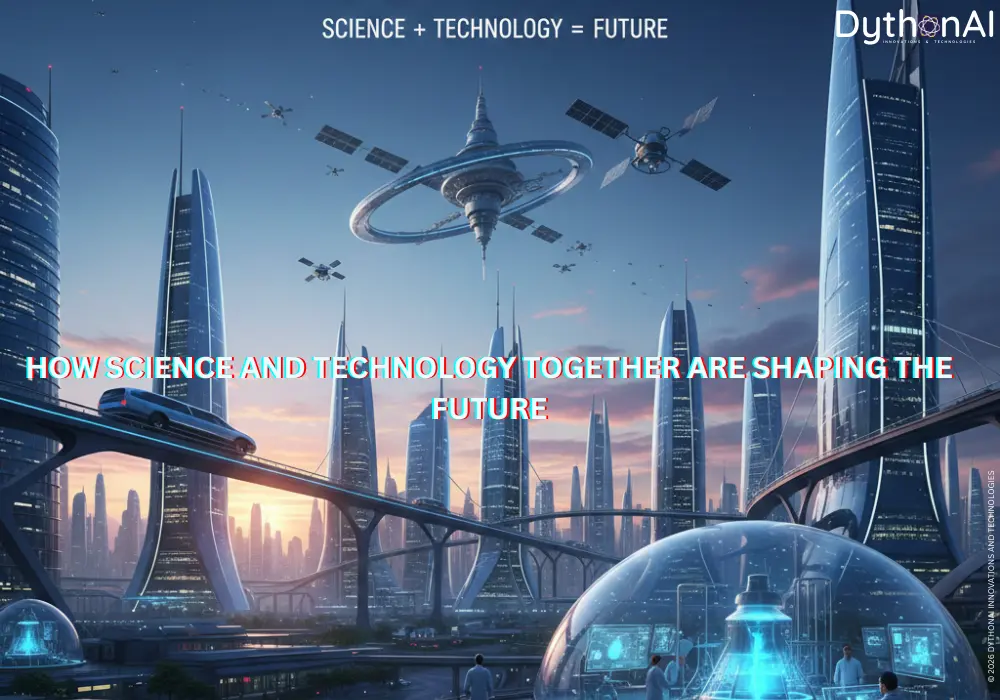
How Science and Technology Together Are Shaping the Future
Introduction
Science and technology have become inseparable forces driving global transformation. Science explores the unknown, asks critical questions, and builds foundational knowledge. Technology takes those insights and turns them into tools, systems, and solutions that reshape industries and societies.
Together, they form a continuous cycle—research fuels innovation, innovation creates impact, and impact drives new research. This cycle is shaping the future faster, smarter, and more responsibly than ever before.
1. Research: The Engine of Progress
Scientific research is the backbone of every meaningful technological advancement. Whether it’s artificial intelligence, biotechnology, climate science, or advanced computing, research provides the evidence, models, and understanding needed to move forward with confidence.
Why Research Matters More Than Ever
-
Data-driven discovery: Modern research leverages big data, simulations, and predictive models to uncover insights at unprecedented speed.
-
Cross-disciplinary collaboration: Breakthroughs now emerge where fields intersect—AI meets healthcare, robotics meets agriculture, and data science meets social impact.
-
Problem-first thinking: Research today is increasingly focused on real-world challenges, from climate resilience to digital transformation.
Without strong research foundations, technology risks becoming unstable, biased, or ineffective. Research ensures accuracy, reliability, and long-term sustainability.
2. Technology as a Catalyst for Scientific Advancement
Technology doesn’t just apply research—it accelerates it.
High-performance computing, cloud infrastructure, and AI-driven analytics allow scientists and engineers to test hypotheses, run simulations, and analyze complex systems in ways previously impossible.
Key enablers include:
-
Artificial Intelligence & Machine Learning for pattern recognition and predictive insights
-
Automation and robotics to reduce human error and scale experiments
-
Digital twins and simulations to model real-world environments safely and efficiently
Technology transforms research from slow, linear processes into agile, iterative systems that adapt in real time.
3. Innovation: Bridging Theory and Reality
Innovation is the bridge between what we know and what we build.
It is not limited to invention—it involves refining ideas, scaling solutions, and ensuring they deliver measurable value. True innovation occurs when technology is designed with usability, efficiency, and impact in mind.
Modern Innovation Is Defined By:
-
Speed: Rapid prototyping and agile development cycles
-
Scalability: Solutions designed to grow with demand
-
Adaptability: Systems that learn, improve, and evolve
-
Ethics: Technology aligned with human values
Innovation today is less about disruption for its own sake and more about purpose-driven transformation.
4. Real-World Impact: From Labs to Lives
The ultimate goal of science and technology is impact—improving lives, optimizing systems, and solving real problems.
Impact Across Key Sectors
Healthcare:
-
AI-assisted diagnostics
-
Predictive healthcare analytics
-
Personalized treatment plans
Education:
-
Adaptive learning platforms
-
Skill-based digital training
-
Remote and inclusive education access
Business & Industry:
-
Intelligent automation
-
Data-driven decision-making
-
Operational efficiency and cost optimization
Sustainability:
-
Smart energy systems
-
Climate monitoring and prediction
-
Resource-efficient technologies
When research-backed technology meets real-world needs, innovation becomes transformational—not theoretical.
5. The Human Side of Technology
As systems grow smarter, the human element becomes even more critical.
Future-focused technology must:
-
Enhance human capability, not replace it
-
Be transparent, explainable, and fair
-
Protect data privacy and security
-
Support long-term societal well-being
Responsible innovation ensures that progress benefits everyone—not just a few.
6. The Future: Intelligent, Connected, and Purpose-Driven
The next phase of science and technology will be defined by:
-
AI-native systems that learn continuously
-
Connected ecosystems across industries
-
Research-led decision-making at every level
-
Sustainable and ethical frameworks
Organizations that invest in research, prioritize innovation, and focus on impact will lead the future—not follow it.
DythonAI Innovations and Technologies: Building the Future with Purpose
At DythonAI Innovations and Technologies, science and technology converge to create intelligent, scalable, and impactful solutions.
DythonAI is committed to:
-
Translating advanced research into practical AI-driven applications
-
Designing innovative systems that solve real business and societal challenges
-
Delivering measurable impact through ethical, data-driven technologies
By combining deep research, cutting-edge innovation, and real-world implementation, DythonAI empowers organizations to make smarter decisions, automate intelligently, and adapt confidently in a rapidly evolving digital landscape.
The future isn’t just being imagined—it’s being built.
And at DythonAI Innovations and Technologies, that future is shaped with science, technology, and purpose at its core.