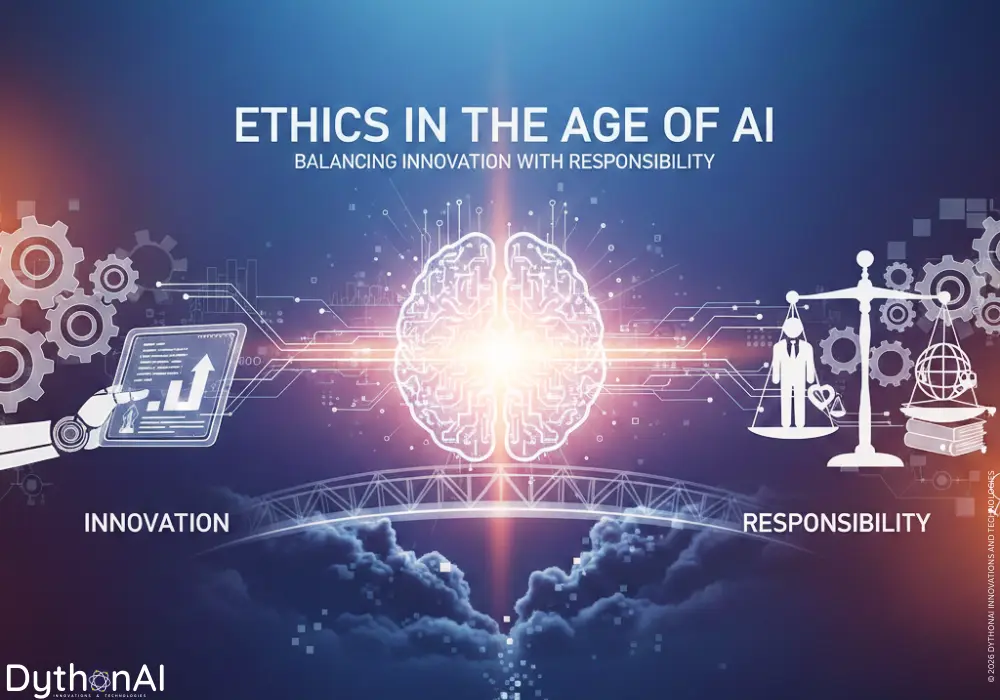
Ethics in the Age of AI: Balancing Innovation with Responsibility
Introduction
Artificial Intelligence is no longer a futuristic concept—it’s embedded in our daily lives. From recommendation systems and virtual assistants to hiring tools and medical diagnostics, AI is shaping decisions that affect individuals, businesses, and societies at large. While this rapid innovation brings enormous potential, it also raises critical ethical questions.
To build AI systems that truly benefit humanity, we must balance innovation with responsibility. Three pillars sit at the heart of this ethical challenge: bias, transparency, and accountability.
1. Bias: When Data Reflects Human Flaws
AI systems learn from data, and data often reflects the imperfections of the real world. Historical inequalities, social stereotypes, and systemic discrimination can easily seep into datasets—leading AI models to reproduce or even amplify existing biases.
Why Bias in AI Is Dangerous
-
Unfair decision-making in hiring, lending, policing, and education
-
Marginalization of underrepresented groups
-
Loss of trust in AI-driven systems
For example, an AI hiring tool trained on past recruitment data may favor certain genders, ethnicities, or educational backgrounds—not because they are better candidates, but because the data reflects biased historical choices.
Addressing Bias
-
Use diverse and representative datasets
-
Regularly audit models for discriminatory outcomes
-
Involve cross-disciplinary teams (ethics experts, sociologists, domain experts)
-
Design AI systems with fairness metrics, not just accuracy
Bias is not just a technical problem—it’s a human and societal one.
2. Transparency: Opening the “Black Box”
Many AI systems, especially deep learning models, operate as “black boxes.” They provide outputs without clear explanations of how decisions are made. This lack of transparency becomes problematic when AI influences critical outcomes.
Why Transparency Matters
-
Users deserve to know how and why decisions are made
-
Regulators need visibility to ensure compliance
-
Organizations need explanations to debug and improve systems
-
Trust cannot exist without understanding
Imagine being denied a loan or rejected for a job by an AI system with no explanation. The absence of transparency can feel arbitrary and unjust.
Building Transparent AI
-
Use explainable AI (XAI) techniques
-
Document data sources, assumptions, and limitations
-
Clearly communicate when users are interacting with AI
-
Avoid over-automation in high-stakes decisions
Transparency doesn’t mean revealing proprietary code—it means making AI decisions understandable and interpretable to relevant stakeholders.
3. Accountability: Who Is Responsible When AI Fails?
When AI systems make mistakes, cause harm, or lead to unintended consequences, an important question arises: Who is accountable?
Is it the developer? The organization deploying the AI? The data provider? Or the AI itself?
The Accountability Gap
Without clear accountability:
-
Harmed individuals have no path to redress
-
Organizations may avoid responsibility
-
Ethical lapses can go unchecked
AI should never be treated as an autonomous moral agent. Responsibility must always rest with humans and institutions.
Ensuring Accountability
-
Define clear ownership of AI systems
-
Establish governance frameworks and ethical guidelines
-
Maintain human oversight, especially in critical applications
-
Log decisions and actions for traceability and audits
Accountability ensures that AI remains a tool—not a scapegoat.
Striking the Balance: Innovation with Ethics
Ethical AI is not about slowing innovation—it’s about guiding it responsibly. Organizations that prioritize ethics gain long-term advantages: trust, credibility, regulatory readiness, and sustainable growth.
By addressing bias, embracing transparency, and enforcing accountability, we can build AI systems that are not only powerful but also fair, explainable, and trustworthy.
Conclusion
As AI continues to evolve, ethical considerations must evolve with it. The choices we make today will define how AI shapes our future—whether as a force for inclusion and progress or one that deepens inequality and mistrust.
Balancing innovation with responsibility is not optional. It is essential.
The future of AI should be intelligent—but also ethical.
Leave A Suggestion

Recent Posts