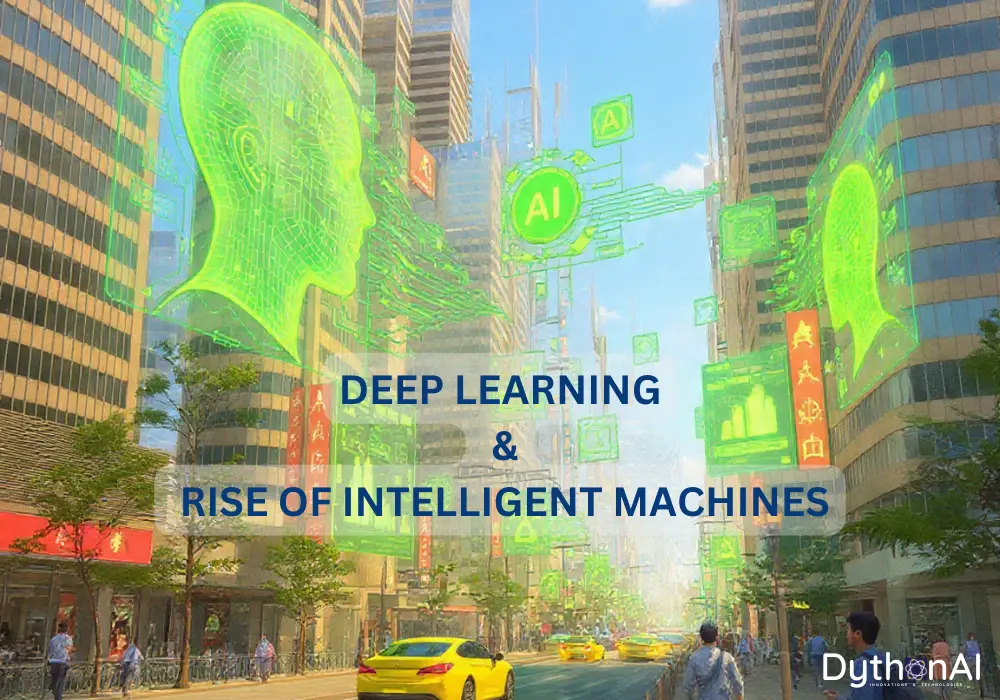
Deep Learning and the Rise of Intelligent Machines
Introduction
Artificial Intelligence (AI) is rapidly transforming the way we interact with technology. From unlocking smartphones with facial recognition to speaking with virtual assistants, intelligent machines are becoming part of everyday life. At the core of this evolution is Deep Learning, a powerful approach that enables machines to learn, adapt, and make decisions with remarkable accuracy—an area actively explored and applied by innovative tech companies like DythonAI Innovations and Technologies.
Understanding Deep Learning
Deep learning is a subset of machine learning inspired by the human brain. It relies on algorithms known as neural networks to process large volumes of data and learn complex patterns. Unlike traditional software systems that depend on predefined rules, deep learning models improve automatically as they are exposed to more data.
This capability makes deep learning particularly effective for working with unstructured data such as images, audio, and text—key elements of real-world intelligence.
Neural Networks: The Backbone of Intelligent Systems
Neural networks consist of interconnected layers of artificial neurons that simulate the way biological neurons communicate. These layers typically include:
-
Input Layer – accepts raw data
-
Hidden Layers – extract meaningful patterns and features
-
Output Layer – delivers predictions or classifications
As data flows through the network, the model continuously adjusts its internal parameters to reduce errors. With enough training, neural networks can recognize patterns, relationships, and abstractions that enable machines to perform intelligent tasks.
Image Recognition: Enabling Machines to See
One of the most impactful applications of deep learning is image recognition. Using Convolutional Neural Networks (CNNs), machines can analyze visual data and accurately identify objects, faces, and scenes.
Image recognition is widely used in:
-
Facial authentication systems
-
Medical diagnostics and radiology
-
Autonomous vehicles and traffic monitoring
-
Security and surveillance
-
E-commerce visual search
CNNs work by detecting visual features such as edges, textures, and shapes, gradually forming a complete understanding of an image. This technology has achieved near-human—and sometimes superior—performance in specific visual tasks.
Speech Recognition: Teaching Machines to Listen and Respond
Deep learning has also transformed speech recognition, allowing machines to understand spoken language with impressive accuracy. Models such as Recurrent Neural Networks (RNNs) and Transformer-based architectures analyze speech patterns over time to capture pronunciation, tone, and context.
Speech recognition powers:
-
Voice assistants and smart devices
-
Automated call centers
-
Real-time transcription services
-
Language translation tools
-
Accessibility solutions
These systems learn from massive datasets of human speech, enabling them to adapt to accents, languages, and real-world noise.
The Rise of Intelligent Machines
By combining neural networks, big data, and advanced computing power, deep learning has given rise to machines that can learn, adapt, and improve continuously. These intelligent systems are now driving innovation across industries such as healthcare, finance, education, transportation, and manufacturing.
Rather than replacing humans, intelligent machines increasingly serve as decision-support tools, enhancing efficiency, accuracy, and productivity.
Challenges and Future Directions
Despite its success, deep learning presents challenges:
-
High computational and data requirements
-
Limited transparency in decision-making
-
Ethical concerns related to bias and privacy
Ongoing research and responsible AI development are essential to ensure these technologies remain fair, secure, and trustworthy.
Conclusion
Deep learning is the foundation behind the rise of intelligent machines. Through neural networks, machines have learned to see, hear, and interpret the world with increasing sophistication. As innovation continues, organizations like DythonAI Innovations and Technologies are helping shape a future where intelligent systems and human creativity work together to solve complex problems and drive technological progress.