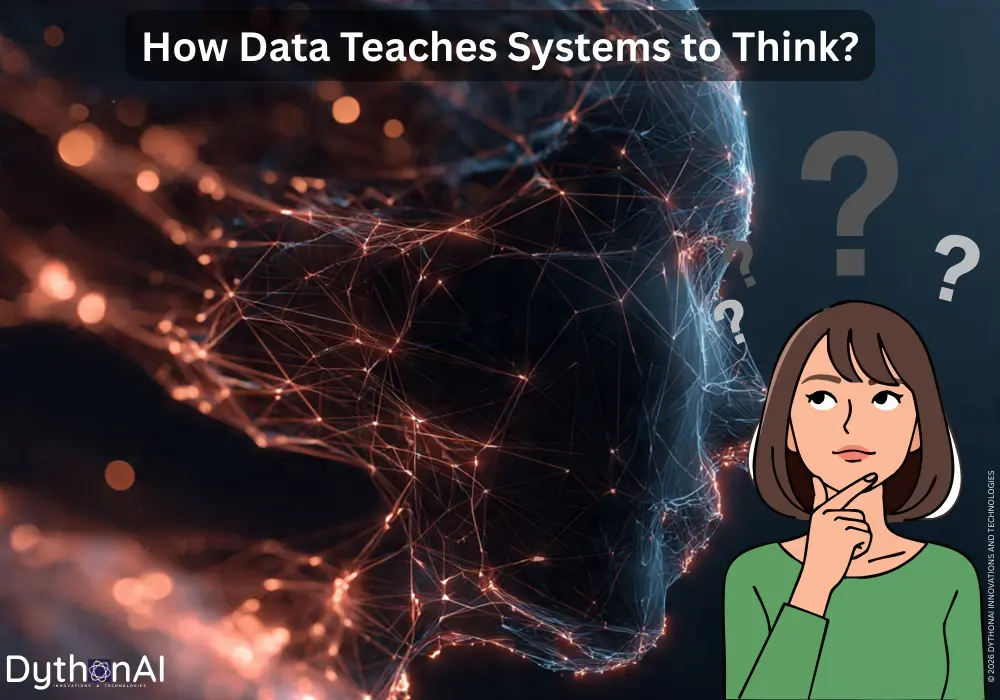
Machine Learning Explained: How Data Teaches Systems to Think
Introduction
Machine Learning (ML) is one of the most influential technologies shaping the modern digital world. From personalized recommendations on streaming platforms to fraud detection in banking and medical diagnosis, machine learning enables systems to improve their performance without being explicitly programmed for every task. At its core, machine learning is about teaching computers how to learn from data—much like humans learn from experience.
This blog breaks down machine learning in a simple, intuitive way and explains how data becomes the foundation that allows systems to "think," predict, and make decisions.
What Is Machine Learning?
Machine Learning is a subset of Artificial Intelligence (AI) that focuses on building systems capable of learning patterns from data and improving over time. Instead of following rigid, rule-based instructions, ML models analyze examples, identify relationships, and make informed decisions when exposed to new data.
In traditional programming:
A developer writes explicit rules.
Data is processed using those rules.
The output is predictable and fixed.
In machine learning:
Data and expected outcomes are provided.
The system learns the rules on its own.
The model adapts as more data becomes available.
How Does Data Teach Machines to Think?
Data is the teacher in machine learning. The quality, quantity, and relevance of data determine how well a machine learning system performs.
1. Data Collection
Everything begins with data. This could include:
Images, videos, or audio
Text (emails, reviews, articles)
Numerical data (sales, temperature, user behavior)
The more representative the data is of real-world scenarios, the better the system can learn.
2. Data Preparation
Raw data is often messy and incomplete. Before learning begins, data must be cleaned and prepared:
Removing duplicates and errors
Handling missing values
Normalizing and structuring data
This step is critical because poor-quality data leads to poor predictions.
3. Training the Model
During training, the machine learning algorithm processes data and looks for patterns. For example:
Identifying spam emails by learning common keywords
Recognizing faces by learning facial features
The system adjusts its internal parameters repeatedly until it minimizes errors and improves accuracy.
4. Learning from Feedback
Many ML systems use feedback to improve. When predictions are correct, the model is reinforced. When wrong, adjustments are made. Over time, this feedback loop helps the system make better decisions—similar to how humans learn from mistakes.
Types of Machine Learning
1. Supervised Learning
The system learns from labeled data, where the correct answer is already known.
Examples:
Email spam detection
House price prediction
Medical diagnosis
2. Unsupervised Learning
The system works with unlabeled data and discovers hidden patterns on its own.
Examples:
Customer segmentation
Market basket analysis
Anomaly detection
3. Reinforcement Learning
The system learns by interacting with an environment and receiving rewards or penalties.
Examples:
Game-playing AI
Robotics
Self-driving cars
Real-World Applications of Machine Learning
Machine learning is already deeply embedded in everyday life:
Healthcare: Disease prediction, medical imaging, drug discovery
Finance: Fraud detection, credit scoring, algorithmic trading
E-commerce: Product recommendations, demand forecasting
Transportation: Traffic prediction, autonomous vehicles
Marketing: Customer behavior analysis, targeted advertising
Challenges in Machine Learning
Despite its power, machine learning comes with challenges:
Data Bias: Biased data can lead to unfair outcomes
Interpretability: Some models act as "black boxes"
Privacy Concerns: Handling sensitive data responsibly
High Data Requirements: Large datasets are often necessary
Addressing these challenges is crucial for building ethical and reliable AI systems.
The Future of Machine Learning
As data grows and computing power advances, machine learning will become even more intelligent and accessible. Future systems will:
Learn faster with less data
Make more transparent decisions
Work collaboratively with humans
Rather than replacing human intelligence, machine learning will continue to augment it—helping people make better, faster, and more informed decisions.
Conclusion
Machine learning is not about machines replacing humans; it is about systems learning from data to support smarter outcomes. By teaching machines through data, we enable them to recognize patterns, adapt to change, and solve complex problems at scale.
At DythonAI Innovations and Technologies, we believe that understanding machine learning is the foundation for building intelligent, ethical, and scalable digital solutions. From AI-powered applications to data-driven business systems, machine learning enables organizations to innovate faster and make decisions with confidence.
As businesses continue to generate vast amounts of data, those who harness machine learning effectively will lead the future. The journey begins with understanding how data teaches systems to think—and using that knowledge to create meaningful impact.
About DythonAI Innovations and Technologies
DythonAI Innovations and Technologies is a forward-thinking technology company specializing in Artificial Intelligence, Machine Learning, and intelligent software solutions. We help businesses transform data into actionable insights and scalable AI-driven products.
Empowering intelligence through data-driven innovation.